
Introduction
Business automation has gone through several stages of development. It began with simple software focused on individual processes, followed by robotic process automation and chatbots. Today, businesses are automating more tasks across their operations than ever before.
Most traditional automation software is rule-based and still requires some level of human input. In 2026, a new form of automation is emerging: AI agents.
AI agents are intelligent software systems capable of understanding information, reasoning about tasks, communicating with business applications, and carrying out actions with minimal or no human involvement.
Although chatbots primarily handle customer interactions, AI agents can execute tasks and make decisions. They can handle customer requests, update CRM records, analyse documents, generate reports, run workflows, or request approval when required.
Modern businesses are no longer only automating isolated processes. They are building intelligent operations.
What Are AI Agents?
An AI agent is software that can gather knowledge, plan actions, interact with systems, and learn from its environment. These agents can complete tasks automatically by using connected tools and business applications.
Traditional rule-based software is built to execute a fixed set of instructions. For example, invoice automation software may receive an invoice, save it in a database, and send a confirmation email.
An AI agent can go further. It can understand the invoice, extract the supplier and payment amount, compare it with a purchase order, identify discrepancies, request approval, update financial records, and notify the finance team.
The main difference is that rule-based software closely follows predefined instructions, while an AI agent can interpret context and make decisions within approved boundaries.
From Chatbots to AI Agents
Chatbots were one of the first widely adopted forms of AI in business. Organisations often use them to automate customer service functions such as answering frequently asked questions.
For example, when a customer asks, “What are your hours of operation?”, a chatbot can provide the correct response. AI agents, however, are designed to perform the business process behind the conversation.
If a customer says, “I want to upgrade my plan,” an AI agent can recognise the request, access the customer account, present available plans, calculate pricing, update the subscription, and send a confirmation email.
A chatbot may still be part of this experience, but it acts as the communication layer while the AI agent completes the operational work.
Chatbots vs. AI Agents
| Feature | Chatbots | AI Agents |
|---|---|---|
| Purpose | Respond to questions | Perform specific business tasks |
| Ability to take action | Limited | Full end-to-end task execution |
| Workflows | Simple processes | Complex, cross-functional workflows |
| Integrations | Limited | Extensive |
| Autonomy | Minimal | High within defined controls |
| Business impact | Communication-centric | Operational impact |
Chatbots will continue to support business processes, but they will increasingly work alongside AI agents, particularly when interacting with customers and employees.
Why AI Agents Matter in 2026
Businesses must meet rising customer expectations, improve operations, use data effectively, reduce costs, and increase productivity. AI agents support these goals by combining automation with contextual decision-making.
Increased Productivity
Many organisations still rely on employees for repetitive work such as data entry, report creation, documentation, follow-ups, and administrative tasks. AI agents can automate this work and give employees more time for strategic and valuable activities.
Improved Customer Experience
Today’s customers expect businesses to recognize their needs and provide fast, effective solutions to their concerns. An AI agent can analyse the context of a message, review past interactions, answer questions, fulfil simple requests, and route complex cases to the right team.
This creates more consistent and personalised customer experiences while improving resolution times and customer satisfaction.
Reduced Costs
AI agents can reduce the effort required for manual and labour-intensive processes. This allows businesses to improve operational efficiency while employees focus on higher-value work.
Better Decision-Making
An AI agent can analyse business data and generate useful insights. It can review sales performance, study market trends, prepare financial reports, assess operations, identify risks, and help predict demand.
How AI Agents Work
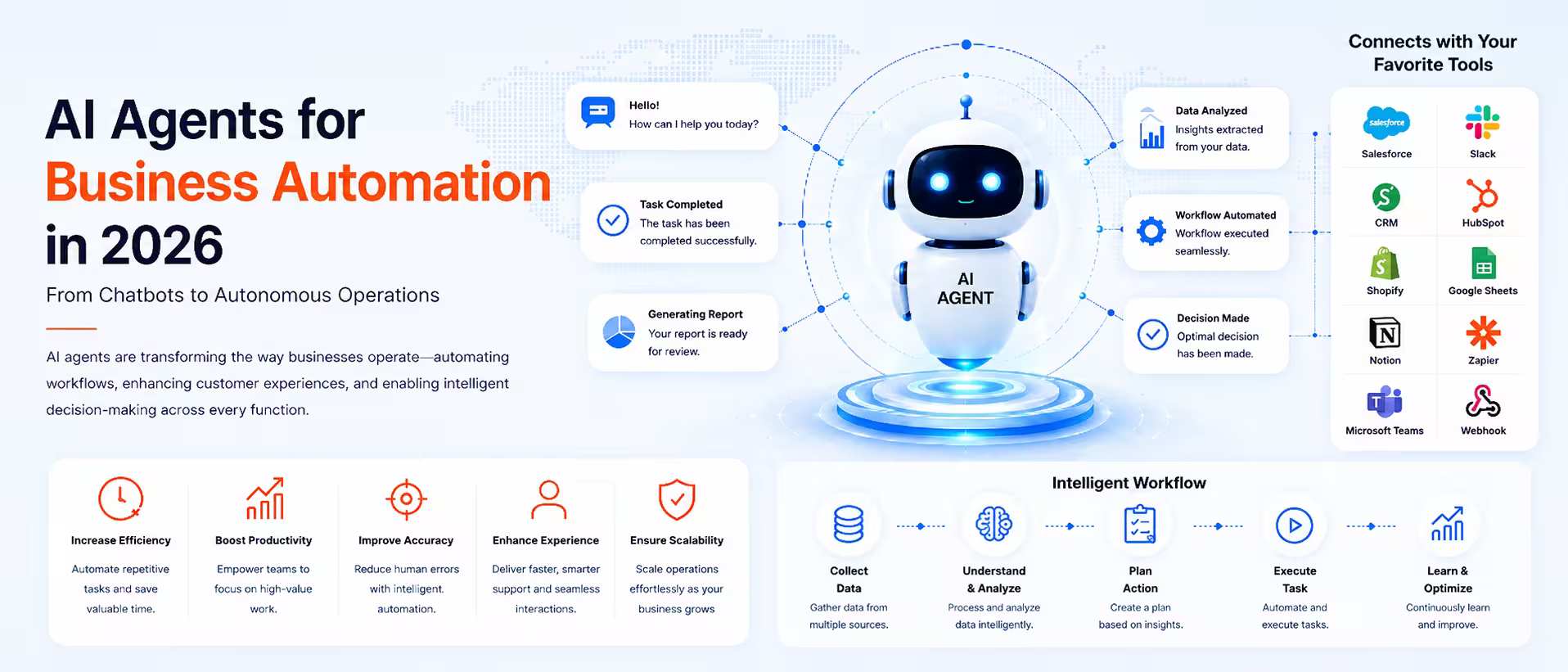
Most AI agents follow a five-step process:
Business Use Cases of AI Agents
AI agents can assist various business functions, such as customer support, sales, marketing, finance, and IT operations.
Customer Support
An AI agent can triage support requests, answer common questions, recommend products, track conversation context, respond to customers, and escalate issues when human assistance is needed.
Final thoughts
AI agents are changing the way businesses think about automation. Instead of simply automating individual tasks, they can connect information, applications, and workflows to support complete business processes.
The real value of AI agents comes from using them where they can solve practical operational challenges. Businesses can start with repetitive, well-defined processes and gradually introduce AI-driven decision-making while maintaining appropriate human oversight and security controls.
As AI technology continues to evolve, autonomous operations will become an increasingly important part of digital transformation. Organisations that combine AI agents with reliable data, clear business rules, strong integrations, and human supervision can build more responsive and efficient operations.
AI agents are not simply the next generation of chatbots. They represent a shift from automating tasks to coordinating intelligent business operations—helping organisations work faster, respond more effectively, and create more scalable processes.